Wednesday, September 8, 2021

Indian Airforce Get 56 C-295 Airbus Transport Aircraft in Make in India deal


The Cabinet Committee on Security, led by Prime Minister Narendra Modi, cleared the long pending Procurement nearly USD 3 billion-deal for procuring 56 Airbus C-295MW transport aircraft for the Indian AirForce (IAF). The aircraft will replace the ageing IAF fleet of Avro 748 transport aircraft that first flew in 1961.

In first of this, 16 aircraft being delivered in flyaway condition from Spain within 48 months of signing of the contract. 

The remaining 48 aircraft will be manufactured in India by the TATA Consortium within 10 years of signing the contract.

This is the first defence contract the European firm Airbus has signed with India since the 1960s despite being in the country for over five decades.

It is also the first project in India in which a military aircraft will be manufactured by a private company.

All 56 aircraft will be installed with the indigenous Electronic Warfare Suite. 

The C-295 is a medium tactical transport aircraft that was designed by the Spanish company CASA in the 1990s as a development of the CASA-Nurtanio CN-235. When CASA was incorporated into the European aeronautical group EADS in 2000, the aircraft was designated as the EADS CASA C-295. It made its first flight on 28 November 1997.

The C-295 is manufactured and assembled in the Airbus Defence and Space facilities in San Pablo Airport, located in Seville, Spain. It is a development of the Spanish–Indonesian transport aircraft CASA/IPTN CN-235, but with a stretched fuselage, 50% more payload capability and new Pratt & Whitney Canada PW127G turboprop engines.

Key Features:-

Crew: 2

Capacity: 73 troops / 48 paratroops / 12 stretcher intensive care medevac / 27 stretcher medevac with 4 medical attendants

Maximum payload: 7,050 kg (15,543 lb) normal
9,250 kg (20,393 lb) overload

Max takeoff weight: 21,000 kg (46,297 lb) normal
23,200 kg (51,147 lb) overload

Maximum landing weight: 20,700 kg (45,636 lb) normal
23,200 kg (51,147 lb) overload

Engines:- 2 × Pratt & Whitney Canada PW127G turboprop engines, 1,972 kW (2,644 hp) each for take-off (normal)
2,177 kW (2,919 hp) with APR

Propellers: 6-bladed Hamilton Sundstrand HS-586F-5, 3.94 m (12 ft 11 in) diameter composite propellers with auto-feathering and synchro-phasing

Others :-

Cruise speed: 482 km/h (300 mph, 260 kn) at optimum altitude

Range: 1,555 km (966 mi) normal payload

Ferry range: 5,000 km (3,100 mi) 

Service ceiling: 4,125 m (13,533 ft) on one engine
Absolute ceiling: 9,145 m (30,003 ft)
g limits: +2.53 (normal MTOW)
+2.25 (overload MTOW)

Take-off run: 844 m (2,769 ft) Sea level, ISA
934 m (3,064 ft) Sea level, ISA + 20
Take-off distance to 15 m (49 ft): 1,025 m (3,363 ft) Sea level, ISA
1,103 m (3,619 ft) Sea level, ISA + 20

Landing run: 420 m (1,378 ft)
Landing distance from 15 m (49 ft): 729 m (2,392 ft)

Weapons & Armament:-
6 Hardpoints (optional: three under each wing) with a capacity of inboard pylons 800 kg (1,764 lb), centre pylons 500 kg (1,102 lb), outboard pylons 300 kg (661 lb)

Radar:-
Honeywell RDR-1400C weather radar
IFR instrumentation, comms and FMS as specified by customers


However, it is yet unclear where the Airbus aircraft will be built, though TATA has an aviation set up in Hyderabad.

Before completion of deliveries, ‘D’ Level servicing facility (MRO) for C-295MW aircraft is scheduled to be set up in India and it is expected that this facility will act as a regional MRO (maintenance, repair and overhaul) hub for various variants of C-295 aircraft, the defence ministry said.

A large number of detail parts, sub-assemblies and major component assemblies of aero structure are scheduled to be manufactured in India. The programme will act as a catalyst in employment generation in the aerospace ecosystem of the country and is expected to generate 600 highly skilled jobs directly, over 3,000 indirect jobs and an additional 3,000 medium-skill employment opportunities with more than 42.5 lakh man hours of work within the aerospace and defence sector of India,” the defence ministry said.

“It will involve development of specialized infrastructure in form of hangars, buildings, aprons and taxiway. During the process of manufacturing in India, it is expected that all the suppliers of TATA Consortium who will be involved in special processes, will gain and maintain globally recognized National Aerospace and Defence Contractors Accreditation Program (NADCAP) accreditation,”.


                           Jai Hind🇮🇳🇮🇳

Friday, July 30, 2021

CDS VISITS FORWARD AREAS IN CENTRAL SECTOR AND HQ WESTERN COMMAND OF INDIAN ARMY


The Chief of Defence Staff (CDS), General Bipin Rawat visited forward areas along the Line of Actual Control(LOC) in the Central Sector in Himachal Pradesh along with GOC, Uttar Bharat Area today. On arrival at the forward most post in Sumdoh Sub-Sector, the CDS was briefed on the operational preparedness of own forces towards safeguarding the territorial integrity of the nation. The CDS interacted extensively with the Indian Army, ITBP and GREF personnel deployed in the remote areas and appreciated their state of high morale. He encouraged all ranks to keep up the high state of alertness and professionalism displayed by them.  
 

General Bipin Rawat visited the Headquarters of Western Command of Indian Army at Chandimandir where he reviewed the operational situation along the Western borders. The CDS commended the formation for their efforts to ensure force preservation and at the same time stepping forward to provide support in terms of establishing COVID hospitals at Chandigarh, Patiala, Faridabad, providing paramedical staff in aid of civil hospitals, assistance in vaccination of common citizens and revitalizing oxygen plants at various places in the nation’s fight against the pandemic. He stressed upon the need to focus on training hard and remain vigilant to thwart the nefarious designs of our adversaries. He emphasized that all ranks must keep themselves abreast with latest trends in information technology, emerging cyber threats and counter measures.

.

.

.

.

                                                      JAI HIND!!!

Monday, June 28, 2021

Raksha Mantri Rajnath Singh Meets with Veterans in Leh during visit to Ladakh...


Raksha Mantri Shri Rajnath Singh interacted with 300 veterans, including Ashok Chakra winner Naib Subedar (Honorary) Chhering Mutup (Retd) and Maha Vir Chakra winner Colonel Sonam Wangchuk (Retd), at Leh, Ladakh on June 27, 2021. In his address, Shri Rajnath Singh lauded the unparalleled dedication of the veterans in ensuring safety and security of the nation, reiterating the Government’s commitment towards the welfare of the ex-servicemen. He said Prime Minister Shri Narendra Modi’s decision to roll out ‘One Rank One Pension’ scheme, ending a decades long wait, was a testimony to the Government’s unwavering commitment towards the welfare and satisfaction of the veterans. “Our aim is to take care of you in the same way as you all have taken care of the security of the country,”.


Lt Governor of Ladakh Shri RK Mathur, MP from Ladakh Shri Jamyang Tsering Namgyal, Chief of Army Staff General MM Naravane and General Officer-Commanding-in-Chief, Northern Command Lt Gen YK Joshi were present on the occasion


Later, Shri Rajnath Singh met the elected representatives of Ladakh Autonomous Hill Development Councils, Leh, Kargil and officials in Leh. 

Earlier in the day, the Raksha Mantri reached Leh on a three-day visit to Ladakh. During his stay, he will inaugurate infrastructure projects constructed by Border Roads Organisation (BRO) and interact with troops deployed in the region.

INS TABAR Deployed to Africa, Europe to Participate in Joint Exercise With Friendly Navies...


Towards enhancing military cooperation with friendly nations, Indian Naval Ship INS Tabar commenced her prolonged deployment on 13 June and will visit a number of ports in Africa and Europe till end September. During port visits, Tabar will conduct professional, social and sporting interactions. The ship will also participate in a number of joint exercises with friendly navies.

During the deployment, INS Tabar will transit across the Gulf of Aden, Red Sea, Suez Canal, Mediterranean Sea, North Sea and Baltic Sea while making port calls at Djibouti, Egypt, Italy, France, UK, Russia, Netherlands, Morocco, and Arctic Council  countries like Sweden and Norway. In addition to PASSEX with host navies of countries being visited, the ship is also scheduled to participate in bilateral exercises like Ex Konkan with Royal Navy, Ex Varuna with  French Navy and Ex Indra with Russian Federation Navy. 


The deployment will also see participation by the ship in the Russian Navy Day celebrations from 22 to 27 July.  

The ship will operate in conjunction with the friendly navies, so as to build military relations, develop interoperability and project long range sustenance. IN undertakes regular overseas deployments particularly in the maritime areas of primary interest. These engagements are aimed to further strengthen maritime security in the region and to consolidate combined operations against maritime threats. These interactions will also offer an opportunity to navies to observe and imbibe the ‘Best Practices’ followed in each other’s Navy. 

INS Tabar, is a Talwar-class stealth Frigate built for Indian Navy in Russia. The ship is commanded by Captain M Mahesh and has a complement of 300 personnel. The ship is equipped with a versatile range of weapons and sensors and is among the earliest stealth frigates of the Indian Navy. The ship is part of the Indian Navy’s Western Fleet which is based at Mumbai under Western Naval Command.


DRDO successfully test New Agni P Ballistic Missile...


DRDO (Defence Research and Development Organisation) successfully flight tested a New Generation Nuclear Capable Ballistic Missile Agni P from Dr APJ Abdul Kalam island off the coast of Odisha, Balasore at 1055 hrs on June 28, 2021. Various telemetry and radar stations positioned along the eastern coast tracked and monitored the missile. The missile followed text book trajectory, meeting all mission objectives with high level of accuracy. 

Agni P is a new generation advanced variant of Agni class of missiles. It is a canisterised missile with range capability between 1,000 and 2,000 kms.

Tuesday, May 11, 2021

Defence Ministry orders light-specialist vehicles from Mahindra Defence for Army...


Providing further boost to ‘Make in India’, Ministry of Defence (MoD) signed a contract with Mahindra Defence Systems Ltd (MDSL) for supply of 1,300 Light Specialist Vehicles to the Indian Army, at a cost of Rs 1,056 crore, in New Delhi on March 22, 2021. The induction of vehicles is planned to be completed in four years.

The Light Specialist Vehicle is a modern fighting vehicle and will be authorised to various fighting units for carriage of Medium Machine Guns, Automatic Grenade Launchers as well as Anti-tank Guided Missiles.


The Mahindra Armored Light Specialist Vehicle (ALSV) is a light armoured specialist vehicle built for use by military and defence forces. It’s designed to be a modular type vehicle allowing for efficient maintenance and it can be upgraded or configured in the field for a wide variety of operational roles. The ALSV offers ballistic protection up to B7, STANAG Level II.

Features :-

Counter-Terrorist Operations

  • Patrolling in High Intensity Areas
  • Special Forces Operations
  • Quick Reaction Teams

  • Conventional Operations

  • Weapon carrier
  • Raids in Open/ Desert Terrain
  • Reconnaissance
  • Border Security
  •  The Light Specialist Vehicle is indigenously designed and developed by MDSL. These combat vehicles are extremely agile with all round protection against small arms fire and will assist small independent detachments which are required to operate this weapon platform in the operational area.

     This is a flagship project showcasing the indigenous manufacturing capabilities of the defence industry and will add another milestone to the ‘Atmanirbhar Bharat Abhiyaan’ and ‘Make in India’ initiative. 

    Navy, Army and IAF finally agree to procure armed drones from US as MQ-9 Reaper in $3 bn deal....


    Impressed with the performance of the two leased Sea Guardian drones, the Navy, Army and the Air Force will finally jointly procure 30 armed versions of the American unmanned aerial system in what could be a $3 billion deal, ThePrint has learnt.

    The decision comes just before US Secretary of Defense Lloyd Austin’s visit to India later this month. Austin’s visit could be a precursor to the impending meet of the ‘Quad’ leaders — US, India, Australia and Japan. 

    According to sources in the defence and security establishment, initially one of the three services were not clear about procuring the armed predator drones but now all three are finally on the same way. 

    They added that the Defence Minister Rajnath Singh-led Defence Acquisition Council (DAC) could take a final decision on this “soon”.

    If approved, this would be the first tri-service procurement since Chief of Defence Staff General Bipin Rawat was appointed to steer the Indian armed forces into a more united force, both in terms of operational doctrine and procurement.

    According to the deal, India will be acquiring 30 MQ-9 Reaper or Predator B, 10 each for the three services.

    The MQ-9B has an endurance of 48 hours and a range of over 6,000 nautical miles. It comes with nine hard-points, capable of carrying sensors and laser-guided bombs besides air-to-ground missiles, with a maximum payload of two tonnes.

    The Navy, which is the lead agency for procurement of HALE (High Altitude Long Endurance) UAVs, will seek the Acceptance of Necessity (AON) from the DAC.

    Thursday, May 6, 2021

    Successful Launches of VL-SRSAM Missile System


    Defence Research & Development Organisation (DRDO) conducted two successful launches of Vertical Launch Short Range Surface to Air Missile (VL-SRSAM). 

    The launches were carried out today from a static vertical launcher from Integrated Test Range (ITR), Chandipur off the coast of Odisha. Indigenously designed and developed by DRDO for Indian Navy, VL-SRSAM is meant for neutralizing various aerial threats at close ranges including sea-skimming targets. The current launches were carried out for demonstration of vertical launch capability as part of its maiden launch campaign. On both occasions, the missiles intercepted the simulated targets with pinpoint accuracy. The missiles were tested for minimum and maximum range. VL-SRSAM with Weapon Control System (WCS) were deployed during the trials. 

    The present trials have proved the effectiveness of the weapon system and few more trials will be conducted shortly before deployment on Indian Naval ships. Once deployed, the VL-SRSAM system will prove to be a force multiplier for the Indian Navy.

    Anti-Tank missile systems Helina and Dhruvastra undergo joint user trials

                     DRDO successfully test-fires indigenously developed anti-tank guided  missile systems from an airborne platform - Frontline

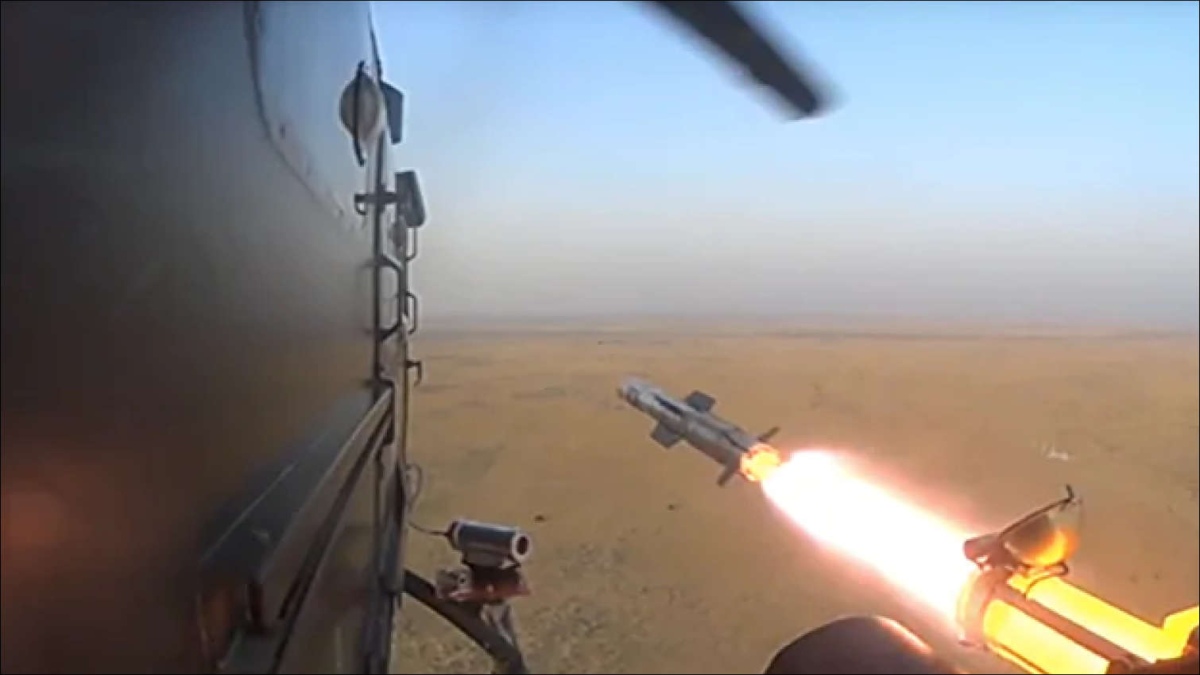
    The helicopter-launched version of the Nag anti-tank guided missile, Helina and its Air Force variant ‘Dhruvastra’ underwent a joint user trial in the desert ranges recently. The missile systems have been designed and developed indigenously by DRDO.

    DRDO officials said.....“Five missions were carried out for evaluating the missile capabilities in minimum and maximum range. The missiles were fired in hover and max forward flight against realistic static and moving targets. Some missions were carried out with warheads against derelict tanks. A mission was carried out against a moving target from a forward-flying helicopter,”. 


                   DRDO successfully conducts user trials of Anti-Tank Guided Missile Systems ' Helina' and 'Dhruvastra' - The Daily Guardian


    Helina, which is the helicopter-launched version of the Nag missile system, is a third-generation fire and forget class anti-tank guided missile (ATGM) system mounted on the ALH. The system has all- weather day and night operational capabilities and can defeat battle tanks with conventional armour as well as explosive reactive armour (ERA). The Helina missile can engage targets both in direct hit mode as well as top attack mode.

    Tuesday, February 16, 2021

    INS Karanj Submarine

    INS Karanj is India’s third of the six Scorpene-class submarines with superior stealth and combat capabilities.

    The Mazagaon Dock Limited (MDL) on Monday delivered the third Scorpene-class submarine to the navy after two years of sea trials. The submarine was launched in January 2018. MDL chairman and managing director,Western Naval Command’s chief of staff officer (technical), signed the acceptance document.

                            Specifications

    Displacement : 1615 T (Surfaced) , 1775 T (Submerged)
    Length : 67.5 m
    Beam : 6.2 m
    Height : 12.3 m
    Draught : 5.8 m
    Propulsion : 4 x MTU 12V 396 SE84 Diesel Engines, 360 x Battery Cells
    Speed : 11 kn (Surfaced), 20 kn (Submerged)
    Range : 12000 km @ 8 kn (Surfaced) , 1020 km @ 4 kn (submerged)
    Endurance : 50 days
    Test Depth : 350 m
    Complement : 8 officers, 35 sailors

                         Armaments

    AEG SUT 264 Torpedo

    The AEG SUT 264 is a German 21 in. heavyweight torpedo. SUT means surface and underwater target. Atlas Elektronik manufactures this torpedo. INS Karanj has six 533 mm Torpedo launch tubes and it can launch 18 AEG SUT 264 torpedos.

    This torpedo is wire guided with active/ passive onboard terminal guidance. It has a range of 28 km @ 23 knots and 12 km @ 35 knots. It is capable of achieveing speeds excess of 35 knots. The warhead is usually 250 kg RDX. Magnetic Field or contact initiates the warhead.


    SM39 Exocet

    MBDA SM.39 Exocet is an anti-ship missile. It has inertial guidance, active radar homing and GPS guidance.

    • Mass : 780 kg
    • Length : 6 m
    • Diameter : 34.8 cm
    • Warhead : 165 kg
    • Engine : Solid Propellant Engine turbojet (MM40 Block 3 Version)
    • Wingspan : 1.35 m
    • Range : 70 – 180 km
    • Sea Skimming
    • Max Speed : Mach 0.93

    INS Karanj can carry 30 mines instead of the torpedoes. As a result, INS Karanj will have the mine warfare capability. 


    C303/S ATCM Electronic Warfare and Decoys

    The C303/S is an anti-torpedo countermeasure system. This system is designed to counter the attacks of acoustic homing torpedoes which includes both active and passive as well as wire and non-wire guided torpedoes. It is formed by a 12 barrel launching network.

    Sunday, February 14, 2021

    PM Modi Dedicate MBT Arjun tank Mk1-A to Indian Army


    In yet another boost for Make in India in defence Prime Minister Narendra Modi will dedicate the Main Battle Tank Arjun Mark1A to the nation on Sunday in Chennai. 

    In a high-level meeting, the defence ministry recently cleared the induction of 118 Arjun Mark1A tanks into the Indian Army which would be worth around Rs 8,400 crore and would add to the strength of the force in land warfare.

    "Prime Minister Narendra Modi would be dedicating the latest version of the Arjun tank to the nation on February 14 in Chennai at the tank production facility in Avadi," Defence Research and Development Organisation (DRDO) officials told ANI.

    The tank has been fully designed and developed by the DRDO in close coordination with the Indian Army. The 118 tanks would be joining the fleet of the first batch of 124 Arjun tanks which have already been inducted into the Army and are deployed in the western desert along the Pakistan front.

    The 118 Arjun tanks would also form two regiments in the Armoured Corps of the Indian Army like the first 124 tanks.

    Officials said the Army has reduced the number of tanks required for the formation of a tank regiment and that is the why the present order has six lesser tanks than the previous order for two regiments.

    The DRDO has been developing the Arjun Mark 1A for quite some time now and the project was hastened by both Chief of Defence Staff Gen Bipin Rawat and DRDO chief Dr G Satheesh Reddy to increase the level of indigenous weapon systems in the armed forces.


    The Arjun has been designed by the DRDO's Combat Vehicles Research and Development Establishment (CVRDE) and DRDO Chairman Satheesh Reddy will hand the first Arjun Mark 1A to Prime Minister Modi.

    The tanks will be produced by the Ordnance Factory Board's (OFB) Heavy Vehicles Factory (HVF) Avadi. 

    The first batch of five main battle tanks will be handed over to the army within two-and-a-half years of the signing of the contract.

    Saturday, January 16, 2021

    ‘‘ASMI” India's First Indigenous Machine Pistol


    In another boost to its defence capabilities, India has now developed its first-ever indigenously made 9mm machine pistol 'ASMI'. As per the Ministry of Defence, the weapon has been jointly developed by the Defence Research and Development Organisation (DRDO) and the Indian Army.


    It has been developed by a young officer from Infantry School Lt Col Prasad Bansod in a record time of four months. The weapon has the capability of firing the in-service 9 mm ammunition. The weapon has been named “Asmi” which means 'pride', 'Self-Respect' and 'Hard Work'.

    A press statement from DRDO informed that the Army's infantry school in Mhow and the DRDO's Armament Research and Development Establishment (ARDE) in Pune have designed and developed the weapon. 


    Structure & Design :

    The upper receiver of ASMI is made from Aircraft grade Aluminium while the lower receiver is created from Carbon Fibre. The weapon has an overall empty weight of less than 2 Kg and it features an 8-inch barrel along with 33 rounds high capacity magazine and machine pistol fires the in-service 9mm ammunition. 
    A 3 dimensional printing process has been used in designing and prototyping of various parts and the machine pistol is likely to have production cost under Rs 50,000 each and has potential for exports. 


    ASMI :

    The weapon has been named “Asmi” which means 'pride', 'Self-Respect' and 'Hard Work'. 


    Ministry of Defence Statement :

    The weapon has huge potential in armed forces as a personal weapon for heavy weapon detachments, commanders, tank and aircraft crews, drivers and dispatch riders, radio or radar operators, for closed quarter battles, counter-insurgency and counter-terrorism operations, etc. This is also likely to find huge employability with the central and state police organizations, as well as VIP protection duties and policing.


                               Jai Hind!!!!!!!! 
                                    🇮🇳🇮🇳

    Saturday, October 3, 2020

    India Successfully test fired a New Version of Nuclear Capable Shaurya missile Today....


    The ongoing border crisis with China, India on Saturday successfully test-fired a new version of nuclear-capable Shaurya missile off the coast of Odisha which can strike targets at around 800 kms.

    The new version of the missile was testfired successfully and would be inducted in the strategic forces to complement one of the existing missiles in the same class.

    The missile would be lighter and easier to operate in comparison with the existing missile.
    In the last phase while moving close to its target, the missile moves at hypersonic speeds, the sources said further.

    The DRDO has been working towards completing total self-reliance in the field of strategic missiles and has enhanced its efforts further after the call of Aatmanirbhar Bharat by Prime Minister Narendra Modi in the defence sector earlier this year, the sources said.

    India also successfully testfired the BrahMos supersonic cruise missile which can hit targets at over 400 km strike range which is at least more than 100 kms from the previous capability of the missile. 

    Tuesday, September 29, 2020

    Indian Navy, Indian Airforce To Get Indigenous SAAW (Smart Anti-Airfield Weapon)


    The Defence Acquisition Council (DAC) headed by the Defence Ministery cleared the procurement of the indigenously developed ‘Smart Anti-Airfield Weapon’ or SAAW for the Indian Navy and the Indian Air Force.

    Developed by the DRDO, SAAW has a range of around 100 km and weighs around 125 kg.

    The weapon, which is being procured at an approximate cost Rs 970 crore, will give the Air Force and the Navy the capability to hit Enemy Airfields and Runways, Bunkers, plane Hanger from a standoff distance with high precision during conflicts.

    Given that this weapon can be launched from standoff ranges, the aircraft launching it can remain at a safe distance from the enemy target. In many cases, the weapon can be fired by IAF fighters like Jaguar & Sukhoi-30 MKI from within the Indian air space.

    Apart from SAAW, the DAC also cleared the procurement of Static HF Trans-receiver sets for field units of the Indian Army and the Air Force at an approximate cost of Rs 540 crore to enable seamless communication.

    Wednesday, September 23, 2020

    A Woman Fighter Pilot Could Fly Indian Airforce Rafale Very Soon


    According to some reports, a female pilot could soon be operating a Rafale in IAF.

    In a first, a woman fighter pilot is all set to be a part of the Rafale squadron of the Indian Air Force in Ambala, according to India Today.

    The women officer, whose name has not been disclosed due to security reasons, is one of the ten female-fighter pilots currently under training. She will begin actively participating in duties along with the 17 Squadron soon. Indian Air Force formally inducted five Rafale fighter jets to the fleet of IAF’s 17 Squadron, the “Golden Arrows” at a glittering ceremony in Ambala air base.

    The pilot has already undergone a full fighter training course and already knows hot to operate MiG-21 fighters. In India, IAF’s 10 women pilots have operated on a variety of aircraft including Su-30 MKI and MiG-29 UPG

    Just four years ago, Flt Lt Avani Chaturvedi, Flt Lt Bhawanna Kanth and Flt Lt Mohana Singh became the first women fighter pilots in the country.

    This may come as an achievement, however, India still has a long way to go.

    Armed forces, in general, have a very low proportion of women personnel. The Air Force has the highest share of women officers in India at 13.9%. Whereas, there are only 6% female officers in Indian Navy. The Indian Army has an even lower proportion of women at only 3.8%.

    Women Officers in Indian Navy

        (Afnan Sheikh, Kreeshma R, Sub Lt. Riti      Singh, and Sub Lt. Kumudini Tyagi.)


    Women officers
    in the Indian Navy are finally taking the lead. For years now, women officers in the Indian armed forces have been in very small numbers.

    According to Indian Navy, four women officers, today, passed the ‘Observe Course” and are set to join their duties.

    Indian Navy’s Sub Lt Kumudini and Sub Lt Riti Singh are the first women officers to be deployed on a frontline warship as crew members. Both the naval officers will work as airborne tacticians. Meanwhile, Sub Lt. Afnan Sheikh and Sub Lt. Kreeshma R. will be operating fixed wing aircraft of the Navy.

    Sub Lt Kumudini and Sub Lt Riti studied engineering and joined the Indian Navy in 2019. They successfully passed Indian Navy’s ‘ Observe Course’ at Southern Naval Command in Kochi on September 21.

    All the four women officers participated in the batch of 21 Navy and Coast Guard personnel.

    This comes as a landmark moment for Indian Navy, which got its first woman Navy pilot, Lieutenant Shivani, just nine months ago.

    Women officers are rising from across the seas to fly higher in the skies.

    Indian Navy & Royal Australian Navy Conduct 2-day Naval Exercise in Indian Ocean from Wednesday


    Navies of India and Australia will carry out a two-day mega exercise in the Indian Ocean Region beginning Wednesday that will involve a range of complex naval manoeuvres, anti-aircraft drills and helicopter operations, officials said.

    The exercise comes in the midst of India's tense border row with China and in the backdrop of growing activities by the Chinese navy in the Indian Ocean Region.

    "The exercise is aimed at enhancing interoperability, improving understanding and imbibing best practices from each other. It would involve advanced surface and anti-air exercises including weapon firings, seamanship exercises, naval manoeuvres and cross deck flying operations," a Navy spokesperson said.

    It will be the fourth major military drill by the Indian Navy since June. It has already carried out similar exercises with the navies of the US, Japan and Russia.

    HMAS Hobart, the lead ship of the Hobart-class air warfare destroyers, will be among the assets to be deployed in the exercise by the Royal Australian Navy, officials said, adding Indian Navy ships Sahyadri and Karmuk will be part of Indian platforms.

    "The exercise, which is in keeping with the strong bond shared by the two navies, would be another step towards strengthening Indo-Australia defence relations and the continued efforts of both governments to work closely to enhance safety and security of the global commons," the Navy spokesperson said.

    He said the two navies have built a robust relationship through regular exercises.

    Earlier this month, navies of India and Russia carried out an exercise in the Bay of Bengal.

    In July, the Indian Navy carried out a military exercise with a US Navy carrier strike group led by the nuclear-powered aircraft carrier USS Nimitz off the coast of Andaman and Nicobar Islands. The USS Nimitz is the world's largest warship.

    In the exercise with the US Navy, four frontline warships of the Indian Navy participated. The US carrier strike group was transiting through the Indian Ocean Region on its way from the South China Sea.

    The US Navy carrier strike group comprises USS Nimitz, Ticonderoga-class guided-missile cruiser USS Princeton and Arleigh Burke-class guided-missile destroyers USS Sterett and USS Ralph Johnson.

    The Indian Navy carried out a similar exercise with the Japanese navy in June.

    India has significantly expanded its deployment in the Indian Ocean Region with a plethora of warships and submarines following the border row to send across a message to Beijing.

    The maritime space around the Malacca Strait is very critical for China's supply chain through sea routes.

    India Conducts Successful Flight Test of ABHYAS from Odisha Test Range


    India on Tuesday successfully conducted the flight test of ABHYAS - High-speed Expendable Aerial Target (HEAT) vehicles from a test range in Odisha.

    The trial, carried out by the Defence Research and Development Organisation (DRDO) from the Integrated Test Range (ITR) at Chandipur near here, was tracked by various radars and electro-optic systems, the sources said.

    Congratulating DRDO on its achievement, defence minister Rajnath Singh said ABHYAS can be used as a target for evaluation of missile systems.


    During the trial on Tuesday, two demonstrator vehicles were successfully test-flown, DRDO sources said.

    ABHYAS has been designed and developed by the Aeronautical Development Establishment (ADE) of the DRDO.

    The air vehicle is launched using twin underslung boosters. It is powered by a small gas turbine engine and has an Inertial Navigation System (INS) along with a Flight Control Computer (FCC) for guidance and control.

    The vehicle has been programmed for fully autonomous flight. The check out of the vehicle is done using laptop- based Ground Control Station (GCS), a defence statement said.

    During the test campaign, the user requirement of 5 km flying altitude, vehicle speed of 0.5 mach, endurance of 30 minutes and 2g turn capability of the test vehicle were successfully achieved, it said.

    “It proved its performance in a fully autonomous waypoint navigation mode,” a DRDO source said.

    Tuesday, September 22, 2020

    New VL-SRSAM Launch System for Indian Navy by DRDO


    VL-SRSAM is a quick reaction point defence system for use against supersonic sea skimming targets like AShM etc including aircrafts , UAVs , munitions etc.

    India’s State Owned DRDO has started work on VL-SRSAM (Vertically Launched -Short-range Surface Air to Missile ) System based on Astra beyond-visual-range air-to-air missile (BVRAAM).

    VL-SRSAM will be developed in two variants for Air Force and Indian Navy. The air force will get high mobility Truck-mounted canister based VL-SRSAM and Navy will get Canister based VL-SRSAM for its frontline warships Each Vertical Launch Unit (VLU) houses 8 heavily modified quick reaction SAMs to engage incoming supersonic projectiles.

    The cannisters are designed to launch missiles in hot-mode, i.e. ignition within the cannister itself & the VLU is designed to launch SAMs in quick succession incase there’s multiple incoming projectiles.

    While DRDO is on the missiles range, but capabilities of a similar missile system should ensure at least 40-50 km in Astra Mk1 configuration and in future Astra Mk2, range will jump to 80km.

    Astra missiles when in its initial developmental phase were tested from a ground-based vertical launch before developmental moved on to IAF’s front-line fighter aircraft like Sukhoi-30 MKIs.

    DRDO keeping in mind possible development of any spin-off of a Ground-based Astra missile system had collected all telemetry data which could also validate its flight performance in the surface to air mode and found it to be capable of performing excellently well even in a surface to air mode.

    VL-SRSAM family will consist of Truck Mounted command and control unit which includes a Radar sensor and 4-6 Missile firing units and replenishments support Truck for the Airforce variant, In Navy, VL-SRSAM variant will be integrated with main and secondary Radar system of the Warship for tracking and detection. The air force is looking for VL-SRSAM ADS which can be transported by C-130 or IL-76 when required, VL-SRSAM will supplement Akash SRSAM.

    VL-SRSAM for its frontline warships which will replace aging Israeli supplied Barak-1 Point Defence interceptor missiles which were procured after India ended its Tri-service Trishul SRSAM.

    Monday, September 14, 2020

    Rafale Officially Inducted into Indian Airforce


    The bird is inducted officially. Yes, the five Rafale aircraft which arrived on July 27 at Ambala Air Force Station were “officially” inducted into the Indian Air Force’s 17 Squadron ‘Golden Arrows’ today (10th September 2020).


    The Defence minister of India Mr. Rajnath Singh, during the induction ceremony presented an induction scroll to Group Captain Harkeerat Singh. Group Captain Singh will be the Commanding Officer of the 17 Squadron of the ‘Golden Arrows’ of the Indian Air Force. The grant of scroll formally indicate the induction of the 5 Rafale fighter jets into the squadron.


    The Defence Minister Mr. Rajnath Singh in the presence of French counterpart said, “The induction of Rafale jets into the IAF has also strengthened the Indo-French relations. We are facing new geostrategic challenges and our two democracies are working together to resolve these challenges.”

    The Defence Minister Rajnath Singh also said that the induction of these jets equipped with state-of-the-art weapons and technology will ensure that India is able to maintain peace in the region and ensure stability. He added, the Indian Air Force’s deliberate and swift action near the LAC displays the professionalism and their commitment towards national security.

    During the ceremony, while speaking from the podium, the Air Chief Marshal R.K.S. Bhadauria, said, “The Rafale aircrafts along with the skills of the 17 Squadron of the ‘Golden Arrows’ will form a lethal combination and will challenge our adversaries.”

    The delighted air chief marshal also thanked the government of India for the continuous efforts towards the strengthening of the Indian Air Force fleet along with the Rafale jets.

    The French minister of armed forcesFlorence Parly” also attended the ceremony. During the ceremony she said, “India will have an edge over its rivals in terms of security with the induction of these jets. The induction will also give a boost to the Make in India initiative.”

    She also said that the induction of the aircraft is symbolic of the friendship between India and France. She also said that France also supports India’s candidacy at the United Nations Security Council. These jets are combat-proven. These jets have helped France undertake counter-terrorism measures.

    The Rafale aircraft was given a water cannon salute after the Sarva Dharma Puja which was attended by the dignitaries along with both the defence ministers and Chief of Defence Staff General Bipin Rawat, air chief marshal RKS Bhadauria.